Incineration (with thanks to Telford PAIN and Dr. Paul Connett)
But incineration makes sense – doesn’t it?
When you first hear about household waste incineration it seems like a good idea. It promises to rid Shrewsbury of leaking landfills and to produce energy as well. It seems like a win-win situation. For a municipal official beleaguered with the responsibility for a mountain of household waste coming at him or her on a daily basis it appears to offer a quick fix solution, with little or no modification of the existing infrastructure for picking up rubbish. For a council with demanding landfill targets to meet, the modern energy from waste incinerator looks like a perfect political escape plan. Your own investigation will soon reveal a different story!
It is only when you spend time looking below the surface appeal of these facilities that you realise the huge backward step they represent, environmentally, socially, economically and from the point of view of moving towards a sustainable society. The incineration of household waste produces toxins and dioxins which are hazardous to health, and toxic ash which has to be transported away to specialised dumps.
Dr. Paul Connett is a professor of chemistry at St. Lawrence University in Canton, New York, USA. He has researched waste management issues with a special emphasis on the dangers posed by incineration and the safer and more sustainable non-burn alternatives for many years.
Dr. Connett says, “Far from it being the universally proven technology claimed by its promoters, the incineration of municipal waste with energy recovery has been an experiment which after 20 years has left the citizens of industrialised countries with a legacy of unacceptably high levels of dioxins and related compounds intheir babies, their tissues, their food and in wild life. Moreover, as they have sought air pollution control devices to capture the extremely toxic by-products of combustion, the resulting residues have become more problematic and costly to handle, dispose and contain.”
Dr Connett argues that for "An Energy from Waste Facility", read "Refuse & Waste Incinerator" & for "Refuse & Waste Incinerator" read "Chemical Reactor" He goes on to point out that when burning fossil fuels to generate power, the chemistry of the combustion process & emmissions is complex but understood. In terms of burning waste, then the complex chemistry varies with the waste content variation & other fuels, & so cannot be predictable. Further, the combustion process & temperatures break down the many complex molecular structures present in waste, which can & do recombine to form new compounds not originally present in the original waste.
Together, we can make a difference! Join our campaign to stop the incinerator in Shrewsbury.


Another Veolia 'ethical' practice - supporting illegal occupation
 Veolia is currently involved in building a light railway linking Israeli colonies in the Occupied Palestinian Territories with Jerusalem; human rights groups have protested about this for some time and some financial institutions have divested/considered divesting from Veolia as a result.
Now it transpires that Veolia is also involved in dumping Israeli waste on Palestinian territory. The writer is an Israeli human rights advocate.
http://electronicintifada.net/v2/article10027.shtml
Veolia involved in Israel's waste dumping in West Bank
Adri Nieuwhof, The Electronic Intifada,
At the entrance of the Tovlan landfill, located beside the
Veolia has a history of juggling with names. In 2005 Onyx became Veolia Environmental Services, also operating in
Consistent with its activities in the light rail project, Veolia claims that the Tovlan landfill is located in
Although located on Palestinian land, Tovlan landfill hardly serves Palestinian communities. Instead, it is used by
In 2004, the International Court of Justice stated that
Adri Nieuwhof is a consultant and human rights advocate.
For more information about Veolia's track record in Israel/Palestine and other countries, email safe_waste_shropshire@yahoo.com.
GIANT INCINERATOR RUBBISHED
A timely warning from Wales.
Meanwhile, Veolia's application for an incinerator at Battlefield is expected to be submitted in 'Mid January' and SITA's application for the Granville incinerator is already in. Keep watching this site and the local media for more details and for help with objecting. People who want to object to the Granville incinerator should look at: http://www.nogranville.blogspot.com/ as a matter of urgency.
It is vital that members of the public object to incineration. If the people responsible for our health and well-being get away with building the incinerators at Battlefield and Granville, we will be paying the price for decades to come with our health and pockets.
Don't believe the hype: incinerators are not safe, clean or the only alternative to landfill. They can be stopped. Read our site, follow the links for more information. Get informed and HELP STOP INCINERATION IN SHROPSHIRE!
------------------------------------------------------------------------------------------------
http://www.newswales.co.uk/?section=Environment&F=1&id=15783
Cardiff giant incinerator rubbished 10/12/2008
A hugely over-sized and polluting waste incinerator plant could be coming to Cardiff if plans submitted to the City Council are given the go-ahead, says the environmental campaigning organization Cardiff Friends of the Earth.
The council received the planning application from waste management company Viridor on November 27 for an incinerator in Trident Park, Cardiff Bay.The timing of the application means that any objections have to be submitted to the planning department by Christmas Eve for a decision early in the New Year.
Heather Webber of Cardiff Friends of the Earth said: "Hauling huge amounts of rubbish around the country to be burnt is not a sensible, or sustainable, waste solution."This incinerator is massively over-sized, and would release dangerous emissions and increase congestion and pollution in Wales' capital city."If this incinerator is given the go-ahead, there will be more than 250 large lorries rumbling through Cardiff every day - feeding the incinerator's demands for a third of a million tonnes of rubbish a year."
Incineration is supposed to be the answer to keeping waste out of landfill, but for the environment, burning rubbish is worse than burying it."There are other, sustainable solutions available - incineration on this scale is absolutely not necessary, will hit recycling rates, and won't be able to adapt to the changing demands of the future."
The timing of the submission in the busy run-up to Christmas would appear to be a cynical move by Viridor to avoid public objection."If we don't want Cardiff to become the waste capital of Wales, residents urgently need to contact the planning department with their concerns."
Meanwhile, Veolia's application for an incinerator at Battlefield is expected to be submitted in 'Mid January' and SITA's application for the Granville incinerator is already in. Keep watching this site and the local media for more details and for help with objecting. People who want to object to the Granville incinerator should look at: http://www.nogranville.blogspot.com/ as a matter of urgency.
It is vital that members of the public object to incineration. If the people responsible for our health and well-being get away with building the incinerators at Battlefield and Granville, we will be paying the price for decades to come with our health and pockets.
Don't believe the hype: incinerators are not safe, clean or the only alternative to landfill. They can be stopped. Read our site, follow the links for more information. Get informed and HELP STOP INCINERATION IN SHROPSHIRE!
------------------------------------------------------------------------------------------------
http://www.newswales.co.uk/?section=Environment&F=1&id=15783
Cardiff giant incinerator rubbished 10/12/2008
A hugely over-sized and polluting waste incinerator plant could be coming to Cardiff if plans submitted to the City Council are given the go-ahead, says the environmental campaigning organization Cardiff Friends of the Earth.
The council received the planning application from waste management company Viridor on November 27 for an incinerator in Trident Park, Cardiff Bay.The timing of the application means that any objections have to be submitted to the planning department by Christmas Eve for a decision early in the New Year.
Heather Webber of Cardiff Friends of the Earth said: "Hauling huge amounts of rubbish around the country to be burnt is not a sensible, or sustainable, waste solution."This incinerator is massively over-sized, and would release dangerous emissions and increase congestion and pollution in Wales' capital city."If this incinerator is given the go-ahead, there will be more than 250 large lorries rumbling through Cardiff every day - feeding the incinerator's demands for a third of a million tonnes of rubbish a year."
Incineration is supposed to be the answer to keeping waste out of landfill, but for the environment, burning rubbish is worse than burying it."There are other, sustainable solutions available - incineration on this scale is absolutely not necessary, will hit recycling rates, and won't be able to adapt to the changing demands of the future."
The timing of the submission in the busy run-up to Christmas would appear to be a cynical move by Viridor to avoid public objection."If we don't want Cardiff to become the waste capital of Wales, residents urgently need to contact the planning department with their concerns."
Vote for Caroline Jackson MEP - environment MEP paid by incineration firm
SHE CAME SECOND!!
http://www.worstlobby.eu/2008/home
Caroline Jackson, Member of the European Parliament
Nominated for her twin roles as an elected representative dealing with environmental issues and as an appointed environmental advisor to a private waste management company, Shanks.
Jackson chaired the Committee on Environment, Consumer Protection and Public Health between 1999 and 2004, and is the UK Conservative Party Environment Spokesperson in Europe. Jackson is paid £6000 as a member of the Shanks environmental advisory board (EAB), a position she still holds.
In 2005/6 Jackson acted as rapporteur for the Waste Framework Directive (WFD), a policy area that clearly interests her private sector employers Shanks plc.
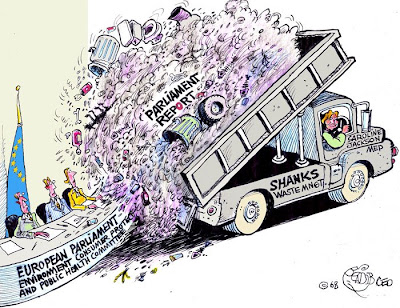
The chair of Shank’s Environmental Advisory Board praised Jackson’s “wide knowledge of European legislation” which it said has “been a benefit to our work”. In the company’s 2006/07 report, Shanks attested “The EC waste framework directive is [...] being revised and as the MEP within the European Parliament responsible for the revision of the Directive, EAB member Caroline Jackson was able to keep us updated on progress during the year. This will have far-reaching implications for waste management and the EAB will consider its impacts on Shanks activities in the UK and mainland Europe.”
Michael Averill, Chief Executive of Shanks, was also the President of the European Federation of Waste Management and Environmental Services (FEAD) until February 2008, which represents the European waste management industry. FEAD ran a ‘consultancy group’ that looked at Jackson’s waste management report and lobbied Jackson three times. So Jackson, as the Rapporteur of a report on the waste framework directive, was lobbied by the industry group headed by the boss of a waste company where she is a consultant!
Despite this rather close relationship Jackson maintains that there is no conflict of interest as Shanks has no interest in incinerating waste. But Shanks website contradicts this, stating that it “remediates PCB and pesticide contaminated soil through high temperature incineration at dedicated facilities in the UK and the Netherlands.”
Vote for Jackson if you are opposed to elected representatives getting too close to private interests and compromising their ability to act in the public interest
Vote here:
http://www.worstlobby.eu/2008/vote/index/worstconflictofinterest
Additional information :
Too Close for Comfort?, Andy Rowell, Spinwatch, July 2008.
About Shanks. Background, Shanks Website, last visited 15 October 2008.
Declaration of Member’s Financial Interests 2007, Caroline Jackson.
MEP on waste company payroll, Andrew Bounds, Financial Times, 13 June 2008.
Safety, Health and Environment Report 2006/2007, Shanks Group.
FEAD Bulletin N°15, June 21 – November 10 2006, European Federation of Waste Management and Environmental Services.
Services. Remediation, Shanks website, last visited 15 October 2008.
http://www.worstlobby.eu/2008/home
Caroline Jackson, Member of the European Parliament
Nominated for her twin roles as an elected representative dealing with environmental issues and as an appointed environmental advisor to a private waste management company, Shanks.

Jackson chaired the Committee on Environment, Consumer Protection and Public Health between 1999 and 2004, and is the UK Conservative Party Environment Spokesperson in Europe. Jackson is paid £6000 as a member of the Shanks environmental advisory board (EAB), a position she still holds.
In 2005/6 Jackson acted as rapporteur for the Waste Framework Directive (WFD), a policy area that clearly interests her private sector employers Shanks plc.

The chair of Shank’s Environmental Advisory Board praised Jackson’s “wide knowledge of European legislation” which it said has “been a benefit to our work”. In the company’s 2006/07 report, Shanks attested “The EC waste framework directive is [...] being revised and as the MEP within the European Parliament responsible for the revision of the Directive, EAB member Caroline Jackson was able to keep us updated on progress during the year. This will have far-reaching implications for waste management and the EAB will consider its impacts on Shanks activities in the UK and mainland Europe.”
Michael Averill, Chief Executive of Shanks, was also the President of the European Federation of Waste Management and Environmental Services (FEAD) until February 2008, which represents the European waste management industry. FEAD ran a ‘consultancy group’ that looked at Jackson’s waste management report and lobbied Jackson three times. So Jackson, as the Rapporteur of a report on the waste framework directive, was lobbied by the industry group headed by the boss of a waste company where she is a consultant!
Despite this rather close relationship Jackson maintains that there is no conflict of interest as Shanks has no interest in incinerating waste. But Shanks website contradicts this, stating that it “remediates PCB and pesticide contaminated soil through high temperature incineration at dedicated facilities in the UK and the Netherlands.”
Vote for Jackson if you are opposed to elected representatives getting too close to private interests and compromising their ability to act in the public interest
Vote here:
http://www.worstlobby.eu/2008/vote/index/worstconflictofinterest
Additional information :
Too Close for Comfort?, Andy Rowell, Spinwatch, July 2008.
About Shanks. Background, Shanks Website, last visited 15 October 2008.
Declaration of Member’s Financial Interests 2007, Caroline Jackson.
MEP on waste company payroll, Andrew Bounds, Financial Times, 13 June 2008.
Safety, Health and Environment Report 2006/2007, Shanks Group.
FEAD Bulletin N°15, June 21 – November 10 2006, European Federation of Waste Management and Environmental Services.
Services. Remediation, Shanks website, last visited 15 October 2008.
UK National Waste Policy – A Bridge Half Built: A Zero Waste Alliance Declaration
 Submission to the Environment, Food & Rural Affairs Committee to examine Waste Strategy for England November, 2008
[PDF version at: http://www.zwallianceuk.org/html/declaration.pdf]
Zero Waste Alliance UK is a company registered by guarantee in England & Wales, company number 04452297, charity registered number 1122168 www.zwallianceuk.org

UK National Waste Policy - A Bridge Half Built
In July 2002 the Zero Waste Charter was launched at the House of Commons, and has since received wide national and international backing. It argued that there was a growing environmental imperative for the reduction, recycling and composting of waste to reduce:
the dangers to human health of incinerators and landfills
CO2 emissions
the pressure on virgin forests, on minerals and on rapidly degrading soils.
The 10 point charter set out a strategy for moving to Zero Waste in the UK, notably by:
maximising the recycling of dustbin and of bulky waste
introducing the doorstep collection of organic waste and a composting infrastructure banning the thermal treatment of mixed waste and the landfilling of untreated biological waste limiting waste disposal authorities to 10 year contracts to ensure flexible facilities to complement the growth of recycling and composting introducing a disposal tax and ear-marking its proceeds to promote Zero Waste.
accelerating and extending producer responsibility legislation
After the launch of the Charter, the Government’s Strategy Unit supported many of the principles of the Charter. It led to a radical increase in the landfill tax. It supported increased rates of recycling and composting, secured additional funding for WRAP to engage in waste prevention and recycling, and for the first time recommended Mechanical and Biological treatment as an alternative to incineration and landfill as a means of handling residual waste.
But it left a bridge half built. And policy has in the meantime slipped back to its previous groove: timid on targets, and a promoter of incineration.
Climate change will not be countered by limited ambition. Leading countries and regions in Europe are now recycling and composting 60% of their municipal waste. The UK remains a straggler. Recycling has doubled in four years, but still stands at no more than 23.5% in 2004/5. DEFRA’s current review proposes a maximum target of 50% by 2020, a level that the best UK authority is already meeting. This sets the bar too low. It offers too little too late.
Holding back recycling and composting and promoting incineration will not reduce CO2 emissions. Yet this has been the consistent thread of Government policy since the Strategy Unit Review:
The UK government is notorious in Europe for its opposition to the EU Bio waste directive, and has had it shelved . The UK Animal By-Products Regulations have set levels of treatment way beyond those operating in the rest of the EU, raising the cost and discouraging the composting of domestic and commercial food waste.
The Government is pressing the EU Commission to redefine incineration as recovery rather than disposal
Funds for PFI waste disposal contracts have been increased, encouraging large scale, capital intensive disposal technologies and 20-25 year contracts and reducing the incentive to maximise recycling1
In proposing long term national targets for incineration, but only modest short term recycling and composting targets for individual local authorities (a maximum of 30% for 2007/8) Government encourages disposal authorities to crowd out recycling and composting by the construction of large scale incinerators.
The escalating landfill tax coupled with LATS, without graduated taxes on other forms of disposal, encourages a switch from landfill to other disposal options rather than the maximisation of recycling and composting.
DEFRA has substituted a tick box sustainability appraisal for the Best Practical Environmental Option, which has facilitated proposals for incineration at public enquiries. In spite of massive local opposition the DTI has approved the proposal for a giant incinerator at Belvedere in East London (up to 800,000 tonnes, making it the largest incinerator in Europe), so creating a long term appetite for paper and plastic from Greater London, that should be recycled to save CO2 emissions. Belvedere’s approval sets a precedent for giant schemes throughout the country.
DEFRA’s current Review is strong on the rhetoric of recycling, but it fails to will the means. It remains a charter for incineration not for Zero Waste. It argues for incineration as a means of countering climate change on two grounds: that it replaces methane producing landfill, and that it substitutes carbon neutral electricity production for fossil fuel power stations. 2
But it under-estimates:
The loss of stored up energy embodied in recyclable materials prematurely incinerated (notably paper, aluminium, organic waste and plastic).
And it takes no account of:
the capture of methane from landfill, which at the high rates assumed elsewhere by DEFRA makes landfill broadly comparable in terms of net CO2 emissions to electricity-only incineration.3
the fact that electricity-only incinerators generate4 more fossil CO2 than gas fired power stations and more in total than coal power stations, while CHP or heat only incinerators are only marginally better than gas fired stations even if the heat is put to good use - not always possible even in areas like Scandinavia where the demand for heat is higher than in the UK5
the sequestration of carbon in depleting soils through the application of compost, or stabilised residues from MBT plants.
the lifecycle energy costs involved (and the waste generated) in the production of the incinerators themselves
Incinerators are producers of brown energy not green. They do not reduce green house gas emissions but increase them, both because of the overall CO2 emissions at their strikingly low current levels of efficiency of 25% or less, and because their destruction of the ‘grey energy’ embodied in the materials they burn increases the need for new energy intensive virgin materials.
The incentive structure and the process of decisions on disposal of waste are tilted towards incineration. Whereas stabilised residues from MBT that are landfilled are subject to the full landfill tax, bottom ash from incinerators is classed as inert, and charged only £2 a tonne.
Far from facing a graduated tax as a means of disposal, incinerators receive more Government funding, and have greater access to private finance, than recycling or composting. Accordingly they remain the technologies of choice for disposal authorities which the Government have left with the decisive institutional power in municipal waste management.6
Even where, because of public opposition, disposal authorities have fought shy of incineration or its modern variants pyrolysis and gasification, they have continued to negotiate 20-25 year inflexible contracts, incorporating Mechanical and Biological Treatment (MBT) plants, that produce ‘refusederived fuel’ as a feedstock. They have made MBT, a potentially more flexiblemeans of stabilising residual organic waste and suitable for the transition to Zero Waste, into a processing arm for incineration, and a barrier rather than a support to Zero Waste strategies.
Zero Waste Alliance Proposals
Zero Waste policies have had to swim against the institutional and policy tide, rather than being carried along by it. The Zero Waste Alliance therefore urges the Government and local authorities to re-orient their policies in the direction of Zero Waste, in line with leading regional and national governments overseas, and further to the 10 points of the original charter, adopt the following specific measures:
1. Set long term recycling and composting targets of 75% for all local authorities by 2015, (and a minimum of 60% for each individual local authority) along with waste minimisation targets, to prevent their crowding out by local and regional long term disposal contracts.
2. Press the EU to introduce the Biowaste Directive, and its requirement for kerbside kitchen waste collections in all cities, towns and villages with over 1,500 population.
3. Switch the government subsidy of PFI schemes to the start up costs of food waste collection and composting, as part of the Treasury’s forthcoming Comprehensive Spending Review.
4. Extend the grant of carbon credits to recycling and composting to reflect their impact on the reduction of CO2 emissions generated by the production of virgin materials.
5. Extend Producer Responsibility Legislation to cover all materials in the household waste stream, and raise the targets for recycling of plastic packaging, glass and metals under existing legislation to those set by the leading countries in Europe.
6. Recognise incineration as disposal not recovery, in line with the EU Waste Framework Directive and rulings of the European Court of Justice.
7. Fund a major research programme to identify the hazards of nano particles, particulate aerosols, and brominated flame retardants that arise from the burning of mixed waste.
8. Introduce an incineration tax of at least £12 per tonne.
9. Charge incinerator bottom ash at the full level of landfill tax (rather than the £2 a tonne which it currently enjoys by virtue of its unwarranted classification as inert waste) and reduce the landfill tax to £6 a tonne for bio-degradable waste, stabilised to the levels set out in the 2nd draft of the Biowaste Directive.
10. Require compulsory insurance against future pollution and health claims for all disposal and recovery facilities.
The past four years have not been wasted. The ground for a radical increase in recycling and composting is now prepared. St Edmundsbury has become the first council to pass the 50% recycling and composting target. The leading continental and North American authorities are now reaching 75%. They mark the path to Zero Waste.
The imperative of climate change has, too, at last been unequivocally recognised by scientists, by the media and now by all major political parties. But it is not reflected in waste policy. In spite of the evidence that recycling and composting lead to major CO2 savings relative to incineration and landfill - WRAP estimates the savings of current levels of recycling and composting at 10-15 million tonnes of carbon equivalent per year7 and in spite of its higher CO2 emissions relative to gas fired electricity generation, the Government is still promoting incineration as a source of green energy.
What is required is return to the boldness of the Strategy Unit’s policy, and a shift of finance and incentives towards composting and recycling. Climate Change policy calls for it. The Government should respect the evidence, free itself from the disposal centred waste industry, and complete the work that was left half finished after the Strategy Unit’s Review.
The Zero Waste Alliance
Zero Waste Charter
The organisations, groups and individuals who have signed this charter are committed to achieving Zero Waste in Britain by 2020. Zero Waste is a new concept being pioneered by leading corporations, municipalities, and now provincial and national governments. It entails re-designing products and changing the way waste is handled so that products last longer, materials are recycled, or, in the case of organics, composted. Waste is in the process of being designed away.
The immediate imperatives behind the drive for Zero Waste are environmental. There is a new awareness of the dangers to human health of waste landfills and incinerators. Landfills are major producers of methane, and polluters of water tables. Incinerators produce greenhouse gases, and are a source of heavy metals, particulates and dioxins.
Zero Waste strikes at the cause of this pollution. It also lightens the ever growing pressure on the world’s forests, soils, and mineral resources by making more with less. Doubling the life of a car saves the 15 tonnes of materials required to make a new one. Recycling paper gives wood fibres six lives rather than one. Increasing the productivity of resources in this way also leads to major savings in energy. Zero Waste will play a central role in cutting CO2 emissions
and sequestering carbon in the soil.
There is a further economic dividend. Redesigning production and increasing recycling to eliminate waste is stimulating a green industrial revolution. New materials and growth industries are emerging, together with a growth in jobs. In Germany recycling already employs more people than telecommunications. In the US, it has overtaken the auto industry in direct jobs. Governments that embarked on policies to reduce waste in order to combat pollution and climate change, are now realising that zero waste is a key element in any post industrial economic strategy.
Municipalities and companies overseas are well on their way to zero waste. They have shown that it is possible to recycle and compost 70% or more of their waste streams with existing product design. Residual materials which are hazardous, or are costly to recycle can then be phased out and replaced by new clean materials that can be returned to use efficiently and effectively.
Increasing numbers of cities and states have adopted the goal of Zero Waste, including Canberra, Toronto, the state of California, and most recently the Government of New Zealand. This charter seeks to extend these pioneering practices to all the municipalities and producers in the UK.
Our starting point is to create zero waste areas where we live and work – in our streets, and villages, in our schools and hospitals, in municipalities and our many different workplaces. We invite local communities, elected councils at every level, and our major institutions and corporations to sign up to these goals, to put in place7 measures to reduce their waste, and to expand recycling and composting with the goal of achieving Zero Waste by 2020.
By ourselves we can only go so far. The current waste regime still favours disposal over recycling. The Government must change this. Many products are difficult or too hazardous to recycle. The Government can change this, too, by making the manufacturers who produce them responsible for the waste that results, and for redesigning products so that they are safe, long lasting and can be easily recycled. We call on the Governments of Britain, Wales, Scotland and Northern Ireland to end a decade of policy timidity and give a lead to the promotion of Zero Waste by adopting the following 10 point plan to transform Britain’s waste economy:
1. Set a target of Zero Waste for all municipal waste in Britain by 2020 (50% by
2010 and 75% by 2015).
2. Extend the doorstep collection of dry recyclables to every home in Britain without
delay
3. Provide doorstep collection of organic waste, and establish a network of local
closed vessel compost plants.
4. Convert civic amenity sites into re-use and recycling centres.
5. Ban from 2006 the landfilling of biological waste which has not been treated and
neutralised.
6. Ban any new thermal treatment of mixed waste and limit disposal contracts to a
maximum of ten years.
7. Extend the Landfill Tax into a disposal tax. Increase its level, and use it to fund
the Zero Waste programmes.
8. Extend Producer Responsibility legislation to all products and materials that are
hazardous or difficult to recycle.
9. Open up waste planning to greater public participation and end the commercial
confidentiality of waste contracts.
10. Establish a Zero Waste Agency to promote resource efficiency and act as a
guardian of public health.
Signed:
1 The National Audit Office report notes that PFI deals take longer to bring to financial close than other types of procurement, and that after nine years, only six residual waste plants are in place or under construction.
2 Defra (2006) Review of England’s Waste Strategy: A Consultation Document, February 2006. Its wording is: “EfW reduces emissions of greenhouse gases in two ways: because the wastes could otherwise go to landfill and generate methane; and because emissions from the biomass fraction of the waste, which are carbon-neutral, are likely to replace those from fossil generation.” p.60
3 Eunomia, A Changing Climate for Energy from Waste, Friends of the Earth, May 2006.
4 Eunomia, op. cit. By 2020 forecast advances in power station technology and the growing proportion of plastic in residual waste means that energy only incinerators will emit twice the fossil CO2 of gas power stations, and probably more than new or refitted coal power stations using up to 20% biomass. Wastes contain both fossil carbon derived from oil and other fossil fuels and biogenic carbon from wood and plants. When biogenic carbon and time are included in the analysis, energy from waste incineration – where only electricity is generated – looks like a mediocre performer (Eunomia 5.2). Indeed, if the residual waste is landfilled after the stabilising treatment now required, it is only marginally better than landfilling. The Eunomia report contains a valuable critique of the ERM Report for DEFRA that has been used to justify the Government’s incinerator policy, see pp.74 sq. and ERM (2006) Impact from Energy from Waste and Recycling Policy on UK Greenhouse Emissions, Final Report for Defra, January 2006
5. Eunomia, p6
7WRAP, Environmental Benefits of Recycling. An international review of life cycle comparisons for key materials in the UK recycling sector, May 2006. The study was based on a comparative review of 55 international life cycle studies, assessing 200 scenarios.
Veolia at the image laundry

Large companies love greenwash and it seems there's always someone waiting to oblige. In 2006, Veolia ES Hampshire, which operates 3 incinerators, was given a 'Green Hero' award by The Green Organisation, a company whose main function appears to be as an image-laundry for large companies: http://www.sourcewatch.org/index.php?title=Green_Apple_Environment_Awards.

'Green Apple Awards' are given to a variety of projects, some genuinely 'green' and some rather less-so. More 'prestigious' initiatives/companies (like, er, Veolia) get 'Green Hero' status.
Veolia is in good company: Green Apple/Hero awards have been awarded to EDF Energy, DHL, Bovis, Defra, McAlpine, Tesco and many other luminaries of green practice.Even the Barnstaple Western Bypass (that's the actual bypass) got one, despite being bitterly opposed by local green campaigners in Friends of the Earth and the Green Party for its destruction of natural habitats and encouragement of car-use etc: http://news.bbc.co.uk/1/hi/england/devon/3117587.stm http://news.bbc.co.uk/1/hi/england/devon/3999003.stm
The Green Organisation also owns Live Earth a company about which there is even less information than its 'parent'. Multi-millionaire owner of the Green Organisation, Jan Telensky, received a Live Earth Award for his own tourist development - AquaCity - a resort in Slovakia. http://jtcompanynews.blogspot.com/2008/06/worlds-leading-green-resort-achieves.html
Winners of the Gold Green Apple in 2008 win a free holiday in...................AquaCity, which is described as 'conveniently positioned within just 8 minutes of Poprad international airport, AquaCity is also just 15 minutes' drive of the dramatic High Tatras Mountains.'
We hope that Green Apple winners are at least offered the green travel option: 'AquaCity is less than ten minutes' walk from Poprad mainline station, with good and inexpensive rail links to main towns and cities throughout Slovakia, including the capital, Bratislava and over the mountains into Poland, to link with Krakow.'
A 'cathedral' for Shrewsbury?
Those people who long for Shrewsbury to achieve city status may get their wish - if Veolia gets its way to build a 'Cathedral of Incineration' at Battlefield.
http://www.veoliaenvironmentalservices.co.uk/hampshire/pages/pdfs/Waste_Watch_20.pdf
THE PORTSMOUTH INCINERATOR: 'The site was highly praised for its elegant design and materials by judge, reporter and architecture critic Tom Dyckoff who said: "This cathedral of incineration has a style of industrial, almost minimalist chic. It's an incinerator that isn't an eyesore."'
As you can see, from the image of the Portsmouth incinerator, below, such a 'cathedral' could knock spots off Battlefield Church and Shrewsbury Abbey......
http://www.veoliaenvironmentalservices.co.uk/hampshire/pages/pdfs/Waste_Watch_20.pdf
THE PORTSMOUTH INCINERATOR: 'The site was highly praised for its elegant design and materials by judge, reporter and architecture critic Tom Dyckoff who said: "This cathedral of incineration has a style of industrial, almost minimalist chic. It's an incinerator that isn't an eyesore."'
As you can see, from the image of the Portsmouth incinerator, below, such a 'cathedral' could knock spots off Battlefield Church and Shrewsbury Abbey......

Subscribe to:
Posts (Atom)